Panzer Aces I: German Tank Commanders of WWII (Stackpole Military History Series) by Franz Kurowski
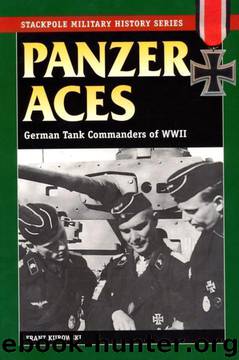
Author:Franz Kurowski
Language: eng
Format: epub
Published: 2012-07-12T02:36:00+00:00
"That will get you home, Hans," said the battalion medical officer. But Sergeant First Class Bolter didn't want to go home, because he knew how desperately every tank commander was needed just then. He was sent to a field hospital just behind the front. Eight days later he returned to his battalion. He had simply walked out of the hospital.
When he reported to Captain Wollschlager at the battalion command post, he learned that his company commander, 1st Lieutenant Bodo von Gerdtell, had been killed on the night of 16 January. First Lieutenant Diehls was the acting commander of the company. Major Marker, the battalion commander, had also been wounded, and Captain Wollschlager was acting in his place. The heaviest losses had been suffered by the crews in the battalion's lightly armored Panzer Ills. These tanks were hopelessly inferior to those of the Soviets. Lieutenant Petz had been killed. 1st Lieutenant Ebert had been badly wounded and lost a leg. Seventeen men from the Panzer III crews had been killed.
Bolter was badly shaken by further bad news. While Colonel Pohlmann was at the front with the 248th Grenadier Regiment directing the defense against a Russian attack, a heavy air attack struck the regiment's command post. Twenty-three officers and men of the tank battalion's trains were killed in one blow. Despite the heavy losses they inflicted on the defenders, the Russians failed to reach their objective, the Kirow railway line. Even so, Leningrad radio reported the breaking of the German blockade on the evening of 18 January 1943. The recapture of Schliusselburg and other ter ritory allowed the Soviets to build a thirty-six kilometer temporary railroad along the southern shore of Lake Ladoga from Polgarni to Schlusselburg. From Schliisselburg the track crossed a makeshift bridge and linked up with the main line to Leningrad. Because this line could be severed at any time by a German counterattack, the Soviet command continued its strenuous efforts in the Leningrad area in hopes of breaking the blockade of the city once and for all. As before, the objective was the Kirow railway line and the important junction at Mga. The second and third phases of the Second Battle of Lake Ladoga then began.
One day after his return, Bolter again climbed into a Tiger. His first mission with his old crew was a local reconnaissance, which was conducted without incident. The next day the Tigers encountered KV-I tanks. Two of these were destroyed and the rest turned and fled into the forest. With this success, Bolter had raised his total of enemy tanks destroyed to thirty-four. On 31.January 1943 the Wehrmacht daily report declared:
Download
This site does not store any files on its server. We only index and link to content provided by other sites. Please contact the content providers to delete copyright contents if any and email us, we'll remove relevant links or contents immediately.
| Africa | Americas |
| Arctic & Antarctica | Asia |
| Australia & Oceania | Europe |
| Middle East | Russia |
| United States | World |
| Ancient Civilizations | Military |
| Historical Study & Educational Resources |
The Radium Girls by Kate Moore(12028)
100 Deadly Skills by Clint Emerson(4926)
Rise and Kill First by Ronen Bergman(4789)
The Templars by Dan Jones(4689)
The Doomsday Machine by Daniel Ellsberg(4490)
The Rape of Nanking by Iris Chang(4213)
Killing England by Bill O'Reilly(4004)
Stalin by Stephen Kotkin(3968)
Hitler in Los Angeles by Steven J. Ross(3946)
12 Strong by Doug Stanton(3550)
Hitler's Monsters by Eric Kurlander(3343)
Blood and Sand by Alex Von Tunzelmann(3205)
The Code Book by Simon Singh(3189)
Darkest Hour by Anthony McCarten(3133)
The Art of War Visualized by Jessica Hagy(3008)
Hitler's Flying Saucers: A Guide to German Flying Discs of the Second World War by Stevens Henry(2754)
Babylon's Ark by Lawrence Anthony(2679)
The Second World Wars by Victor Davis Hanson(2526)
Tobruk by Peter Fitzsimons(2518)
